
Amid increasing volatility and recession fears looming over global markets that has led to the decline in wealth of a number of billionaires, Gautam Adani was the only one to buck the trend. The billionaire added $43.3 billion in net worth between Diwali 2021 (November 4) and this year's Diwali (October 24) according to Bloomberg data. He added more wealth than the gross domestic product (GDP)of more than a dozen Indian states.

Prime Minister Narendra Modi visited Ethiopia on a bilateral visit, engaging with Ethiopian leadership to strengthen partnerships in various sectors. He was warmly welcomed by Prime Minister Abiy Ahmed Ali and participated in cultural events, highlighting the strong ties between the two nations.

From the Sensex firms, Adani Ports, Bharat Electronics, Eternal, Tata Motors Passenger Vehicles, State Bank of India and Kotak Mahindra Bank were among the biggest gainers. However, ITC, Bajaj Finance, Titan and Tech Mahindra were the laggards.

The rupee recovered 55 paise from its all-time low level to close at 90.38 against the US dollar after a volatile trade on Wednesday, amid suspected aggressive central bank intervention.

'An asset must generate income. Equities yield dividends, bonds pay coupons, deposits give interest, and real estate earns rent.' 'Gold, silver, and even Bitcoin produce no income, they merely store value. So, they should not be compared to productive assets.'

The power sector presents a puzzle. A fast-growing economy should be aligned to higher power demand but that hasn't been the case in the financial year 2026 till date (FY26TD).

Describing the "lower agriculture output" as the "immediate challenge", Nomura said it could be a drag on GDP in the next quarter and on rural consumption. "But we expect urban consumption to rebound due to better job prospects," it said.

Prime Minister Narendra Modi on Thursday invited global businesses to participate in the growth story of India, which is the fastest growing large economy of the world.

India's merchandise trade deficit widened to a record $41.68 billion in October, as gold imports trebled and outbound shipments registered their sharpest contraction in 14 months, according to data released by the commerce department.

Global rating Moody's on Monday affirmed India's long-term local and foreign-currency issuer ratings and the local-currency senior unsecured rating at 'Baa3' with a 'stable' outlook on the back of robust economic growth and sound external position. The rating agency also affirmed India's other short-term local-currency rating at P-3.
Fitch Ratings on Monday affirmed India's sovereign rating at 'BBB-', with a stable outlook, saying a strong record of delivering growth and improving fiscal credibility will drive improvements in structural metrics. "India's ratings are supported by its robust growth and solid external finances," Fitch said, as it forecast GDP growth of 6.5 per cent in the fiscal year ending March 2026 (FY26), unchanged from FY25, and well above the 'BBB' median of 2.5 per cent.

Industry lobby groups on Tuesday said the slowdown in India's GDP growth in the fourth quarter of 2010-11 was mainly on account of high interest rate regime, aimed at taming inflation.

The Indian Premier League (IPL) 2015 made a contribution of Rs 11.5 billion (USD 182 million) to India's GDP, a survey conducted by top financial auditing firm KPMG on behalf of the BCCI has said.

Investors must account for currency depreciation in their financial plans and use instruments that can cushion the erosion in purchasing power.

A Lancet report reveals a significant increase in deaths attributable to PM2.5 pollution in India, with fossil fuels being a major contributing factor. The report highlights the economic and health consequences of air pollution and the urgent need for a transition to cleaner energy sources.
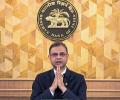
Shrugging off concerns over the depreciation of rupee, the RBI has cut interest rate by 25 basis points to 5.25 per cent in a bid to further bolster economic growth, which rose to a six-quarter high of 8.2 per cent in the second quarter of the current financial year.

Foreign investors have pulled out Rs 11,820 crore ($1.3 billion) from Indian equities in the first week of this month, primarily driven by the sharp depreciation of the rupee. This sharp withdrawal follows a net outflow of Rs 3,765 crore in November, further pressuring markets.

'Things may get much worse before they get better,' predicts Ajay Chhibber.

The ratio of market capitalisation to gross domestic product (GDP) in India remains elevated despite the recent correction in the equities markets. It was 147.5 per cent on December 3, 56 per cent higher than the 10-year average of 94 per cent. The current ratio is slightly lower than the all-time high ratio of 154 per cent at the end of September this year.

The World Bank on Tuesday raised India's growth forecast for the current fiscal to 6.5 per cent from 6.3 per cent estimated earlier, and said the country is expected to remain fastest-growing major economy, underpinned by continued strength in consumption growth.

The Asian Development Bank (ADB) on Wednesday slashed India's GDP growth forecast for FY23 to 7 per cent from the earlier estimate of 7.2 per cent mainly on account of higher inflation and a tight monetary policy. India's economy grew 13.5 per cent year-on-year in the first quarter of 2022-23, reflecting strong growth in services, ADB said in its second supplement to Asian Development Outlook Report 2022 (ADO 2022). "However, GDP growth is revised down from ADO 2022's forecasts to 7 per cent for FY2022 (ending March 2023) and 7.2 per cent for FY2023 (ending March 2024) as price pressures are expected to adversely impact domestic consumption, and sluggish global demand and elevated oil prices will likely be a drag on net exports," ADB said.

Shrugging off concerns over the depreciation of rupee, the RBI has cut interest rate by 25 basis points to 5.25 per cent in a bid to further bolster economic growth, which rose to a six-quarter high of 8.2 per cent in the second quarter of the current financial year.
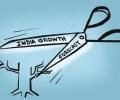
The Indian economy is estimated to grow at 7 per cent in the 2022-23 fiscal, down from 8.7 per cent a year ago, mainly due poor performance of mining and manufacturing sectors. As per the first advance estimates of national income released by the National Statistical Office (NSO) on Friday, the manufacturing sector output is estimated to decelerate to 1.6 per cent in the current fiscal from 9.9 per cent in 2021-22. Similarly, mining sector growth is estimated at 2.4 per cent in the current fiscal as against 11.5 per cent in 2021-22.

"The policy of Macaulay, which sowed the seeds of mental slavery in India, will complete 200 years in 2035. This means there are 10 years left. Therefore, in these very 10 years, we all must come together to free our country from the slave mentality," he said.

S&P also cut China?s GDP growth forecast to 7.5%t and that of rest of Asia.

India's GDP is likely to grow at 6.5 to 7 per cent in the current fiscal year amid global challenges which may impact exports, said Economic Survey 2023-24 tabled in Parliament on Monday. The growth projected for 2024-25 is lower than the economic growth rate of 8.2 per cent estimated for the previous financial year. The Reserve Bank has projected the GDP growth for the fiscal year ending March 2025 at 7.2 per cent.

The growth of India's services sector eased in September from the recent high in August, as new business and activity expanded at slower rates, according to a monthly survey released on Monday.
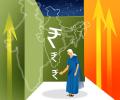
NITI Aayog member Arvind Virmani on Monday said India is set to become the fourth largest economy in the world by the end of 2025, an assertion which came days after NITI CEO BVR Subrahmanyam claimed India has already overtaken Japan to reach that spot. The International Monetary Fund (IMF), in its World Economic Outlook (WEO) report released in April had said that India is expected to be the fourth largest economy in the world with a GDP of $4.19 trillion in 2025, ahead of Japan.
Moody's Ratings on Tuesday said tax cuts in the current fiscal has dented India's revenue growth, leaving less scope for fiscal policy support for the economy.

'Rate cut looks unlikely and there is reason to believe that the cycle is over.'

The best course for the government at this time would be to tighten the seat belt a little more, without compromising on its investments in creating better infrastructure and giving a push to privatisation, points out A K Bhattacharya.

Bengaluru is at a critical juncture, where its economic model, reliant on attracting and retaining skilled professionals, is directly threatened by a measurable decline in urban quality of life, point out Shishir Gupta and Rishita Sachdeva.

'Given that the economy is going through a slowdown, further downward revisions of the 2019-2020 growth estimates cannot be ruled out,' notes A K Bhattacharya.

Equity markets this week would keenly track the upcoming GST Council meeting, macroeconomic data announcements and trading activity of foreign investors for further movement, analysts said. Moreover, developments related to tariff negotiations, global market trends and auto sales data would also drive investors' sentiment.

Online video platform YouTube's ecosystem has contributed over Rs 10,000 crore to India's GDP and supported more than 7.5 lakh full-time equivalent jobs in the country, according to a report. In India, over 4,500 channels had over 10 lakh subscribers and the number of YouTube channels in India making Rs 1 lakh or more in their annual revenue increased by over 60 per cent year-over-year in 2021, the YouTube Impact Report based on analysis by Oxford Economics said. "YouTube's creative ecosystem contributed over Rs 10,000 crore and supported more than 7,50,000 full-time equivalent jobs in the Indian economy in 2021. "That economic impact shows up in four ways, through direct, indirect, induced, and catalytic impacts," the report said.

'Earnings growth will be the main driver of India's market in 2026, with profits expected to rise 9% to 10% in H2 FY26 and accelerate to 12% to 15% in FY27.'

Finance Minister Nirmala Sitharaman on Friday said the world is facing "profound imbalances" in trade and energy security, and is undergoing a structural transformation, with India standing out as a 'stabilising force' that can withstand external shocks.

'The danger is that when the music stops, the fall will be sudden, faster, and deeper than anyone expects,' warns Debashis Basu.

India's economic growth slowed to 7.4 per cent in the March quarter, bringing down the annual growth rate to 6.5 per cent during 2024-25, according to official data released on Friday. The growth in the January-March period was lower than the 8.4 per cent expansion in the year-ago quarter.

Using the debt-to-GDP ratio as a fiscal anchor aligns with efforts to promote fiscal transparency through proper disclosure of off-budget borrowings.
 © 2026 Rediff.com - Advertise with us - Disclaimer - Privacy Policy - Sitemap - Feedback - About us - Terms of use - Grievances